Quick Answer
For most climbers, 7–8 days is the ideal duration to climb Kilimanjaro. It gives your body enough time to acclimatise, improves your chances of reaching the summit, and makes the experience more comfortable and enjoyable.
Shorter options (5–6 days) exist, especially on the Marangu route, but they come with a lower summit success rate because the body has less time to adjust to the altitude. This guide breaks down the ideal duration for each route, explains why more days help, and helps you choose the right duration for your fitness, budget and goals.
Why Duration Matters on Kilimanjaro
Kilimanjaro is not technically difficult, but it is physically demanding because of the altitude. The main challenge is not walking — it is giving your body enough time to adjust to lower oxygen levels as you climb higher.
When you climb too quickly, your body does not have time to produce more red blood cells and adapt to the thinner air. This increases the risk of altitude sickness, which can cause headaches, nausea, dizziness and fatigue — and in serious cases, force you to turn back.
More days on the mountain means more time for your body to adjust. This is why 7–8 day itineraries consistently have higher summit success rates than 5–6 day itineraries. [626][630][633]
Route-by-Route Duration Guide
Marangu Route
Marangu is the only route that uses huts instead of tents. It is often marketed as the “easiest” route, but this is misleading — the 5-day version has weak acclimatisation and a lower summit success rate (around 50–65%). [625][630][631]
If you choose Marangu, always choose the 6-day version to give yourself an extra day for acclimatisation. This improves your comfort and your chances of reaching the summit.
Machame Route
Machame is the most popular route, known for its varied scenery and challenging sections. The standard itinerary is 6–7 days, with the 7-day option giving better acclimatisation and a higher success rate (around 70–85%). [625][630][634]
Machame is a great choice for climbers who want scenery, adventure and a physical challenge.
Lemosho Route
Lemosho is widely considered the best all-round route, especially for first-time climbers. It approaches from the west, crosses the beautiful Shira Plateau, and joins the Machame trail before heading to the summit. The 7–8 day itinerary gives the body more time to acclimatise, which is why Lemosho consistently records some of the highest summit success rates — often around 85–90% or higher. [625][627][629]
Lemosho is the best choice for climbers who want scenery, a quieter start and strong acclimatisation.
Rongai Route
Rongai approaches from the north, near the Kenyan border, and is one of the quieter routes on the mountain. It is drier than the southern routes, making it a good option during the rainy seasons. The standard itinerary is 6–7 days, with success rates around 80–85%. [625][630][635]
Rongai is a good alternative for climbers who want a quieter experience, or who are travelling during the wet season when the southern routes can be muddy.
Northern Circuit Route
The Northern Circuit is the longest route, usually 8–9 days, and circles the quiet northern side of the mountain before joining the summit approach. Because of its length and gradual acclimatisation profile, it has the highest summit success rate of any route — often 90–95% or higher. [625][628][630]
The Northern Circuit is ideal for climbers who want the best possible chance of reaching the summit, and who are happy to spend more days on the mountain.
Umbwe Route
Umbwe is the shortest and steepest route, approaching from the south. It is considered the most difficult route and is generally recommended only for experienced high-altitude trekkers. The standard itinerary is 6–7 days, with success rates around 60–70%. [625][630][635]
Umbwe is not recommended for first-time climbers because of its rapid ascent and lower acclimatisation profile.
Success Rates by Duration
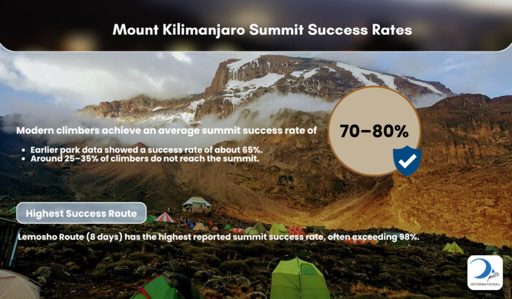
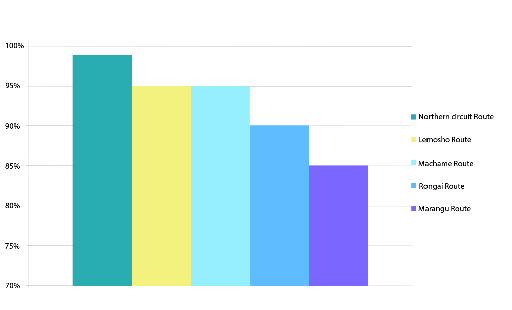
The data is clear: more days on the mountain means a higher chance of reaching the summit.
Summit Success Rates by Itinerary
- 5 days: 50–65% success rate (Marangu only)
- 6 days: 70–85% success rate (Machame, Rongai, Marangu)
- 7 days: 85–90% success rate (Lemosho, Machame, Rongai)
- 8 days: 90–95% success rate (Lemosho, Northern Circuit)
- 9 days: 95%+ success rate (Northern Circuit)
What Affects Your Ideal Duration
1. Your Fitness Level
If you are new to high-altitude trekking, choose a longer route (7–9 days). If you are experienced and confident, a 6-day option may be enough.
2. Your Budget
More days mean higher costs (more park fees, more crew, more food). If budget is tight, a 6-day Machame or Rongai route is a good balance.
3. Your Time Available
If you only have a week, a 6-day route is realistic. If you have 10+ days, consider an 8–9 day route for the best experience.
4. Your Goals
If summiting is your main goal, choose a longer route. If you want a shorter, more affordable adventure, a 6-day route is fine.
How to Choose the Right Duration
Choose 5–6 days if you:
- Are on a tight budget
- Prefer hut accommodation (Marangu)
- Have limited time
- Are confident in your fitness
Choose 7–8 days if you:
- Are a first-time climber
- Want the best balance of comfort and success
- Want scenery and a quieter start
- Are worried about altitude
Choose 8–9 days if you:
- Want the highest possible summit success rate
- Have the time and budget
- Want the most comfortable and enjoyable experience
Frequently Asked Questions
Is 5 days enough to climb Kilimanjaro?
It is possible on the Marangu route, but the success rate is lower because of weak acclimatisation. Most climbers choose 7–8 days for a safer and more enjoyable experience. [626][630]
What is the best duration for a first-time climber?
7–8 days is ideal for most first-time climbers, especially on the Lemosho route. [625][627]
Does a longer route improve my chances of summiting?
Yes — more days means more time for acclimatisation, which improves your chances of reaching the summit safely. [626][630]
Which route has the highest success rate?
The Northern Circuit (8–9 days) has the highest success rate, often 90–95% or higher. [625][628]
Can I climb Kilimanjaro in 6 days?
Yes — Machame, Rongai and Marangu all have 6-day options, with good success rates (70–85%). [625][630]
What is the cheapest duration?
5–6 days is cheaper, but it comes with a trade-off in summit success rate. [625][630]
Does fitness affect the ideal duration?
Yes — if you are new to high-altitude trekking, choose a longer route (7–9 days). If you are experienced, a 6-day option may be enough. [626][630]
Can I combine Kilimanjaro with a safari?
Yes — many climbers combine Kilimanjaro with a Serengeti, Ngorongoro or Tarangire safari, or with a Zanzibar beach holiday afterwards.